Display-Selector
Switch display & audio
with one keypress.
A lightweight Windows 11 system-tray utility
Free, and self-contained with per-user installer. No admin rights or .NET runtime needed.
Explore the open-source code, create an issue, download releases on GitHub.
Manage Profiles for Switching Displays and Audio
Stays out of your way but changes settings with one keypress.
Named Profiles
Capture your current monitor arrangement — active displays, primary screen, resolution, and orientation — as well as audio output device as a named Profile you can recall instantly.
Audio Device Switching
Routes both application audio and System Sounds to the new device. Audio-only Profiles let you swap sound without changing your display layout.
Global Hotkeys
Switch profiles from anywhere — desktop or inside a fullscreen app — using F9–F12 by default. Hotkeys are fully remappable from the Profile menu.
Focus Mode
Excluded displays drop to low-power state so monitors you've switched away from are neither distracting nor wasting energy.
Lightweight System Tray
Lives quietly in the Windows system tray. Optionally launches at startup.
Portable and Private by Design
No background services, no admin rights, no .NET runtime required. All app data stays local under %LOCALAPPDATA%\DisplaySelector.
Setup in Three Steps
From install to switching display and audio Profiles in about a minute.
Open Display-Selector from the system tray
After installing and running Display-Selector, click the  icon in your Windows system tray to open the main menu. Note: The app is unsigned, so Windows SmartScreen may warn: choose More info → Run anyway. Need detailed install instructions? Check out the README on GitHub.

Save display and/or audio Profiles
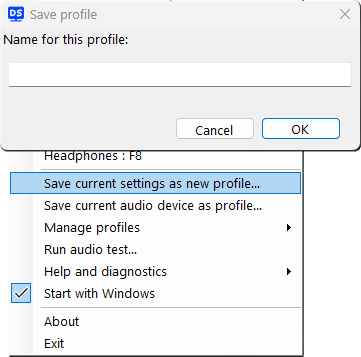
Arrange your displays and audio device the way you like, then choose Save current settings as new profile… from the menu. In the Save profile dialog, type a name and click OK.
Switch between Profiles via HotKeys
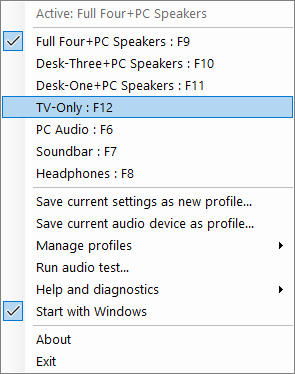
Switch anytime by clicking a profile in the menu — or just press its hotkey (assigned to F9–F12 by default). Want a different key? Reassign any profile’s hotkey from its menu.
Test and Assign Audio
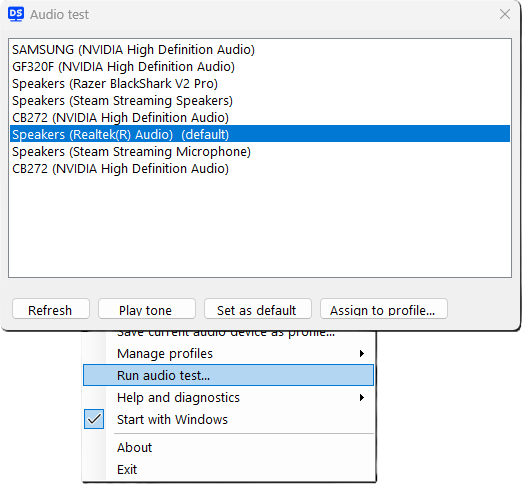
Open Run audio test… to play a test tone through any connected audio device, set it as the default for all Profiles, or assign it to any profile — attach the right speakers or headphones to any Profile.
Frequently Asked Questions
Is Display-Selector free?
Yes. Display-Selector is completely free and open-source, licensed under Apache 2.0. There are no ads, trials, or paid tiers.
Does it require administrator rights or the .NET runtime?
No. It installs per-user with no administrator rights, needs no .NET runtime, and runs no background services. All app data stays local under %LOCALAPPDATA%\DisplaySelector.
Which version of Windows do I need?
Display-Selector is built and tested for Windows 11.
Why does Windows SmartScreen warn me when I run it?
The app is unsigned, so Windows SmartScreen may show a warning. Click More info, then Run anyway to launch it.
Can I switch audio devices without changing my display layout?
Yes. Audio-only Profiles let you swap the sound output on its own, and switching audio routes both application audio and Windows System Sounds to the new device.
How do I switch between profiles?
Click a profile in the system-tray menu, or press its global hotkey. Hotkeys default to F9–F12, are fully remappable, and work even inside fullscreen apps.
Display-Selector is free and open-source, licensed under Apache 2.0.

Found a bug? The app can submit Issues to GitHub under the 'Help and Diagnostics' menu. Browse open issues
Built with Claude Code 🤖 — your support helps cover the API credits.
✨ Support Display-Selector